

Grateful & Present This Holiday Season

Grateful & Present This Holiday Season
How to Move Through the Holidays with an Open Heart (and Keep Doing Good)
You feel it in your chest — a small tightening as the days shorten and the calendar crowds. The holidays arrive like a tidal wave of plans, plates to prepare, expectations to meet, and—if you’re honest—a quiet ache that says, something in me wants this season to mean more than to-do lists and perfect décor.
That ache is an invitation. It’s the tender edge of awareness asking you to slow down, to remember that the holidays are not merely a season of activity but a season of presence. And when we answer that invitation with simple practices—rooted in mindfulness and gratitude—we shift the whole tenor of our experience. We move from doing to being, from exhaustion to nourishment, from scarcity to the recognition that we are, in fact, one with the world around us.
In this piece I’ll share the why and how—why gratitude isn’t just a nice idea (it’s scientifically helpful), why mindfulness is not a luxury (it’s a nervous-system tool), and how, in practice, small acts of presence can transform holiday overwhelm into steady joy. I’ll also offer concrete rituals you can use daily, family ideas for Thanksgiving, and ways to carry this presence into the larger arc of the holiday season.
Why gratitude and mindfulness matter (the science, in brief)
Decades of research show what contemplative traditions have always known: gratitude and mindfulness change us from the inside out. Gratitude practices—like noting three things you’re thankful for—are linked to better sleep, improved mood, and stronger relationships. Researchers Robert Emmons and Michael McCullough found that practicing gratitude measurably improves psychological and physical well-being. PubMed+1
Mindfulness-based programs, like Jon Kabat-Zinn’s MBSR, reduce stress and anxiety and improve attention and emotional regulation. These aren’t just soft claims—reviews and clinical studies document measurable benefits for mood and physical health. If your nervous system has been sprinting for months, mindfulness provides a practical set of tools to come back to center. PMC+1
During the holidays, when stimuli increase and routines shift, these tools act like an inner thermostat: they lower the temperature of reactivity, making room for wiser choices and more compassionate presence. Harvard Health and other outlets have summarized how gratitude improves health markers and well-being, which is why intentionally cultivating gratitude during busy seasons is both practical and potent. Harvard Health
Reframing the holiday story: presence over perfection
Many of our seasonal anxieties come from an internal script: the holidays must be perfect, everyone must be pleased, and you must somehow hold it all together. But what if the story changed? What if the point wasn’t to produce the perfect holiday, but to practice presence—repeatedly, imperfectly, and with curiosity?
Presence is the simplest form of love. It’s showing up without the need to fix. It’s listening when your partner speaks, laughing when your child is delighted, and letting some invitations pass when your energy says no. Presence signals to your nervous system that you are safe enough to be open, and that alone transforms how you experience the season. Greater Good and Mindful offer practical ways to structure moments of presence during holidays—simple practices that help people move from autopilot to awake, one breath at a time. Greater Good+1
Practical rituals for grounding and gratitude (doable, evidence-based)
Below are rituals you can do in 2, 5, or 10 minutes—designed to regulate your nervous system, cultivate gratitude, and connect you to the larger web of life.
- Two-minute breath reset (anytime) — Pause. Breathe in for four counts, hold two, breathe out for six. Repeat 4 times. This slows heart rate and interrupts reactive spirals. Use it before a family dinner, a long drive, or after a stressful call. Research on mindfulness shows short practices like this can reduce reactivity and restore clarity. PMC+1
- Three-thing gratitude check (morning or night) — Write three small things you’re grateful for. Emmons’ gratitude work shows that this simple counting practice increases optimism and life satisfaction. Make it specific: “the shape of sunlight on the table,” “my neighbor’s laugh,” “a hot cup of tea.” Specificity deepens the brain’s response. PubMed+1
- Nature touch (5–10 minutes) — Step outside, put your bare hands in soil or grass, and name three natural things you appreciate. Forest-based therapies and “shinrin-yoku” research show that contact with nature reduces cortisol and improves mood—exactly what we need during sensory overload. Even a short nature pause brings your attention into the body and reminds you that we are part of the living world. TIME+1
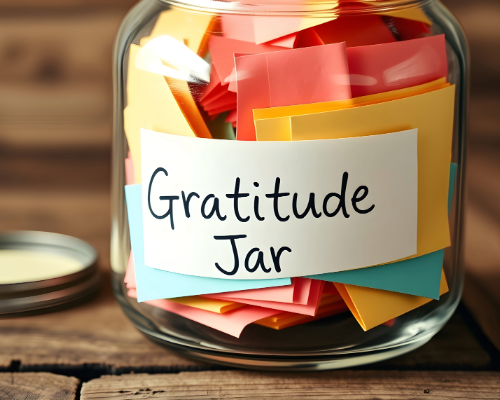
- “Presence at table” ritual (Thanksgiving adaptation) — Before the meal, invite everyone to silently hold one thing they’re grateful for, then pass the bowl or a gratitude jar. People can whisper or write and drop a note into the jar. Mindful platforms and Greater Good both recommend family practices like this to deepen connection and reduce performance anxiety around gatherings. Mindful+1
When feelings of overwhelm show up: a compassionate framework
If your chest tightens or you feel flat amid the holiday bustle, don’t reach for quick fixes. Try this three-step approach—feel, ground, act—that blends psychology and spirituality.
- Feel it, don’t fix it. Allow emotion to be present without immediate problem solving. Research into emotion regulation shows acceptance reduces intensity and duration of distress. Naming grief, stress, or disappointment gives you a choice about what to do next. Harvard Health
- Ground in connection. Use body-based practices—breath, touch, nature—to return to embodied presence. Studies on MBSR and forest therapy confirm the calming, restorative effects of these practices. Even a short grounding resets the nervous system and opens space for compassionate action. PMC+1
- Take aligned action. Small, value-aligned choices build momentum—calling a faraway relative, donating a meal, choosing a sustainable gift, or setting a boundary around your calendar. Research in positive psychology shows celebrating small wins sustains motivation and prevents burnout. This is not about doing more; it’s about doing what lights you up. Greater Good+1
We are all one: a spiritual perspective that changes what we do
Across wisdom traditions is the same radical claim: we are not separate from Earth or from each other. Indigenous traditions, like the Lakota phrase “Mitákuye Oyasin” (all my relations), teach that care for the Earth is care for ourselves. Joanna Macy’s “Active Hope” invites us to feel our grief and then act from love—not from denial. When we embody that practice, activism becomes devotion and service becomes spiritual practice. Tapestry Institute+1
This perspective reframes holiday choices. Giving becomes embodied gratitude. Shopping mindfully becomes a moral vote. Sharing a meal becomes a sacred act of reciprocity rather than a performance. When you see yourself as intimately connected with the Earth and other people, your small acts ripple outward with surprising potency.
Closing: small practices, big-hearted change
The holidays are not a test of your perfection. They are an invitation to practice presence, to remember we are woven into one living web, and to translate feeling into humble, steady action. The science supports this: gratitude shifts brain and body, mindfulness soothes the nervous system, nature reconnects us to what truly matters. Put those practices together and you have a robust path through the season—one that honors grief and celebrates joy, that grounds action in love, and that recognizes the truth we were raised to remember: we are not separate.
If you’re interested in starting today, try this micro-practice: stop for one minute, place a hand on your heart, breathe three slow breaths, and name one thing you’re grateful for. Then do one small action that reflects that gratitude. Wear your values, show up gently, and trust that these tiny seeds grow into the world we want to live in.
What to do this season
- Set a “news boundary.” Limit doom-scrolling to scheduled times so awareness can inform action without drowning in anxiety. (Headspace and Greater Good advise boundaries around news consumption for mental health.) Headspace+1
- Practice the two-minute reset before family events. PMC
- Start a gratitude jar at your next gathering. Pull notes when spirits dip. Mindful
- Choose one aligned action this week—donate, volunteer, switch one habit—and celebrate it. Small choices compound. Greater Good
- Spend time outside each day if you can—nature is medicine. TIME
Recent Posts


Categories
- Conscious Awakening
- Energy & Frequency
- Mindset & Beliefs
- Planet, Purpose & Conscious Living
- Self-Love & Inner Worth